Pluto May Reveal the Hidden Disk of the Solar System: A New Solar ICM Update
From Ulysses to Voyager, this update reads the Solar System as a measured local circulation cell, not empty distance around the Sun.

ICM Update — The Solar System as a Local Circulation Cell
Author: Artur Chindyaskin
Relation to Core Model: Fractal Extension of Interlayer Circulation / Local Disk Analogue
Status: Preliminary conceptual update
Core ICM framework: Interlayer Circulation Model
Previous updates:
State Gradient, Thermodynamics, and Flow Expansion
Messier 51 Galaxy: Axial Structures That Challenge Standard Models
Gaia and the Reality of Outward Redistribution
Spiral Galaxies as Instruments of Cosmic Orientation
The Galactic Barometer. Halo Asymmetry as a Spatial Density Indicator
AI-Assisted Galactic Anisotropy Mapping
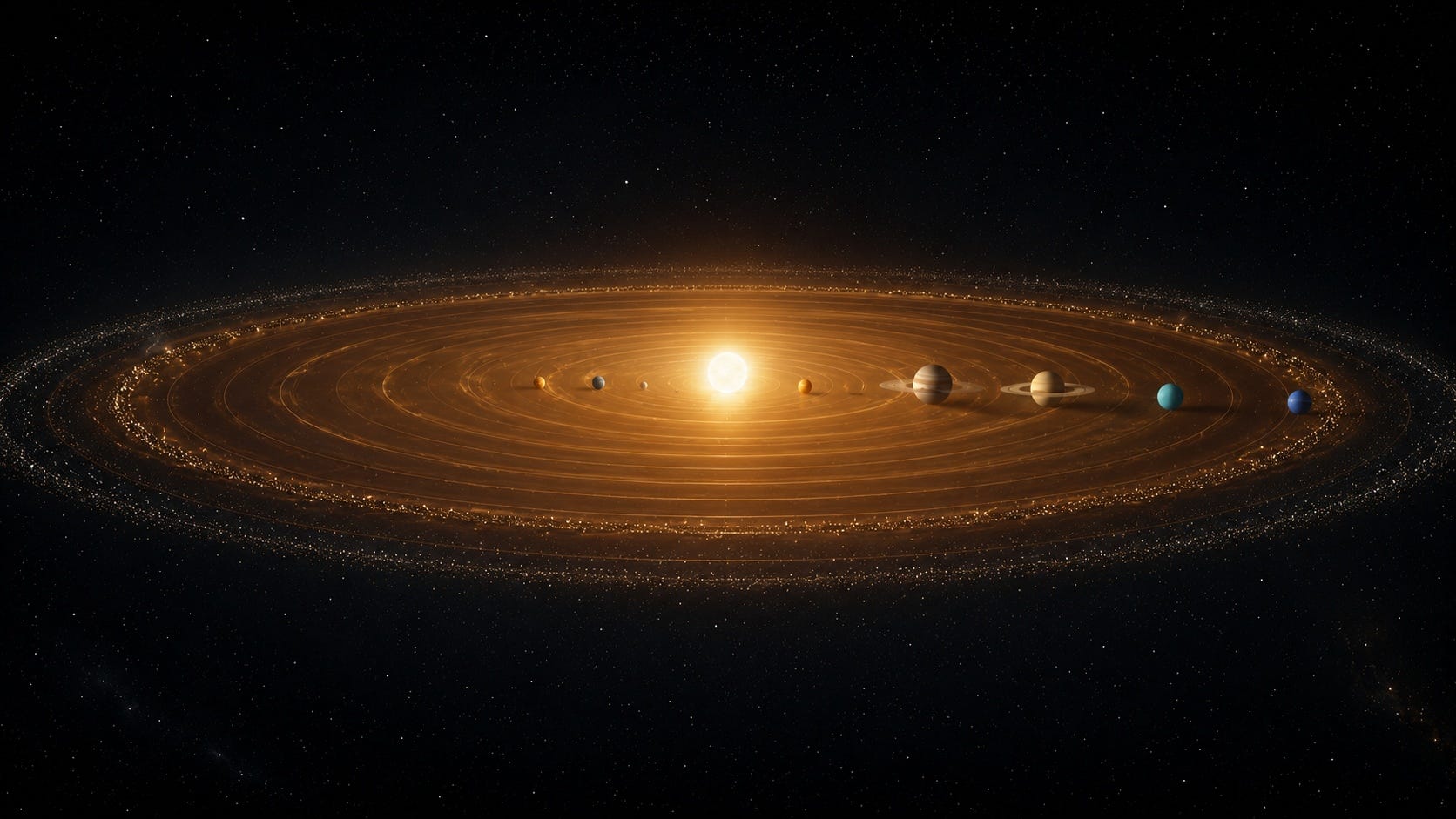
Figure 1 — Conceptual illustration of the Solar System as a local structured disk, highlighting the planetary orbital plane, the Kuiper Belt, and the Oort Cloud as outer components of a coherent system.
Conceptual illustration created for explanatory purposes within the ICM framework.
1. Scope
Previous ICM updates focused on galaxies as large-scale structures embedded within a medium.
They examined:
galactic disks as interlayer systems;
spiral arms as field-guided transport structures;
halo asymmetry as a spatial density indicator;
galaxy spin as a possible polarity readout;
AI-assisted anisotropy mapping as a method for extracting environmental vectors.
This update introduces a smaller-scale extension of the same logic:
the Solar System may be read as a local circulation cell.
The central question is:
can the Solar System be interpreted not merely as a collection of planets orbiting the Sun, but as a flattened, spinning, layered, plasma-magnetic, medium-embedded structure that reflects the same circulation principles observed at galactic scale?
In this view, the Solar System becomes a local analogue of ICM architecture.
Not identical to a galaxy in size, composition, or visible luminosity.
But structurally similar in pattern:
central energetic region;
outward flow;
disk-like organization;
layered thickness;
peripheral rim;
boundary shell;
exchange with a surrounding medium.
The focus of this update is Pluto.
Not because Pluto is the largest or most important body in the Solar System.
But because Pluto may act as a rim marker of the Solar System’s outer circulation layer.
Pluto is not treated here as an isolated anomaly.
It is treated as a diagnostic object.
A peripheral marker.
A boundary clue.
A possible indicator of the structure, thickness, resonance, and outer cadence of the Solar System’s disk-like architecture.
This update therefore asks a different kind of question.
Not only:
what force acts on Pluto at a distance?
But:
what structure carries Pluto as part of the outer Solar System?
That distinction is central.
A distant object may not be fully understood by imagining only a center and an isolated body.
It may need to be read as part of a layered orbital medium.
2. The Scale Shock: Pluto and the Problem of Distant Coupling
A simple scale model reveals the problem.
If the Sun is represented as a sphere approximately two meters across, Earth would orbit roughly 170 meters away.
Pluto would orbit nearly seven kilometers away.
This image is not introduced as a proof against any existing formula.
It is introduced as a conceptual shock.
It forces the observer to ask:
what does it really mean for a distant peripheral object to remain part of a system at such enormous separation?
The ordinary mental image is misleading.
It imagines the Sun as a central object “holding” distant bodies across empty distance.
But ICM suggests another reading:
a distant orbit may not be maintained only by a direct center-to-object relation.
It may be maintained by participation in a structured orbital medium.
In this interpretation, Pluto is not merely a small object far from the Sun.
It is a marker of the outer layer of a disk-like system.
The correct question is not only:
how does the Sun hold Pluto?
The deeper question is:
what kind of disk, layer, field, pressure, resonance, and surrounding medium makes Pluto’s orbit part of a stable outer architecture?
This is the starting point of the update.
The scale model matters because it changes the imagination of the problem.
A distant body at the outer rim should not be pictured as a disconnected object pulled across empty distance by a single invisible line.
It may be better read as a participant inside a broad orbital layer whose structure is defined by spin, resonance, plasma, dust, boundary pressure, and the surrounding medium.
The scale shock therefore does not end the discussion.
It opens the real question:
is Pluto held only by distance-based central coupling, or is it embedded inside a disk-medium structure that carries, constrains, and organizes the outer Solar System?
ICM explores the second possibility.
The purpose of this scale model is not to replace measurement with intuition.
It is to reveal the inadequacy of a simplified mental image.
The Solar System should not be imagined as a small center connected to distant objects through featureless emptiness.
It may be more accurately read as a system of structured layers.
3. From Point Attraction to Structured Orbital Medium
ICM does not begin with the image of isolated bodies moving inside featureless space.
It begins with the idea of structured medium.
At galactic scale, this means:
disks;
fields;
plasma structures;
pressure gradients;
surrounding layers;
environmental constraint.
At Solar System scale, the equivalent may include:
the ecliptic plane;
the invariable plane;
zodiacal dust;
the solar wind;
the heliospheric current sheet;
the Kuiper Belt;
resonant orbital populations;
the heliosphere;
anomalous cosmic rays;
the surrounding interstellar and galactic environment.
This changes the interpretation.
The Solar System is not read as a central sphere plus distant points.
It is read as a disk-medium system.
The planets are not simply “placed” around the Sun.
They occupy layers within a larger rotating architecture.
The outer objects are not merely distant leftovers.
They may preserve the structure, thickness, rhythm, and boundary behavior of the whole system.
In this framework:
Pluto becomes a diagnostic object.
It is not only peripheral.
It is informative.
Pluto may reveal the outer behavior of the Solar System’s disk-like structure.
It may show where the compressed inner order begins to loosen, where resonance becomes more visible, where thickness increases, and where the local circulation system begins to interact more strongly with its surrounding environment.
The central shift is this:
the Solar System is not interpreted as isolated motion through empty distance.
It is interpreted as organized motion inside a layered medium.
This shift parallels the wider ICM view of galaxies.
A galaxy is not read only as matter rotating in an empty background.
The Solar System should not be read that way either.
4. The Solar System as a Miniature Disk-Like Structure
The Solar System has a strong disk-like organization.
Most major planets orbit close to a common plane.
Most orbit in the same direction.
The system has a shared angular-momentum structure.
There is a flattened distribution of dust and small bodies.
The Kuiper Belt extends beyond Neptune as a broad outer region of icy bodies.
The solar wind expands outward from the Sun and forms a heliospheric boundary where the Solar System meets the surrounding interstellar medium.
These features suggest that the Solar System should not be imagined as a sphere of empty distance.
It should be read as a flattened circulation structure.
In ICM terms:
the Solar System is a local circulation cell embedded inside the galactic medium.
The Sun acts as the central energetic region.
The planets occupy organized orbital layers.
The ecliptic plane acts as a compressed transport layer.
The Kuiper Belt forms an outer disk/rim zone.
Pluto acts as a resonant marker of that rim.
The heliosphere acts as the outer boundary shell.
Anomalous cosmic rays indicate that this shell is not merely a limit, but also an exchange interface.
This is the first core claim of the update:
the Solar System may be a local fractal analogue of galactic circulation.
The analogy is not based on identical size.
It is based on repeated architecture:
center → outward flow → disk → rim → shell → surrounding medium
This does not mean that the Solar System is literally a galaxy.
It means the Solar System may express, at a smaller scale, the same structural language that ICM applies to galactic systems.
A central energetic source.
A flattened rotating layer.
A peripheral rim.
A boundary shell.
An external medium.
That architecture matters.
Because once it is recognized, Pluto becomes more than a distant object.
It becomes a readable marker of the outer architecture.
5. The Sun as a Local Crucible
In galactic ICM, the central region is not treated primarily as a consuming endpoint.
It is treated as a Crucible-like energetic source:
generating outward flow;
organizing fields;
shaping transport channels;
structuring the surrounding medium.
The Sun provides a local analogue.
It is not merely a luminous mass at the center.
It is an active energetic source.
It emits radiation.
It produces solar wind.
It carries magnetic structure outward.
It creates a heliosphere.
It shapes the medium surrounding the planetary system.
In this sense:
the Sun functions as the local Crucible of the Solar System.
The key ICM distinction is the vector.
The central region is not interpreted only through inward relation.
It is interpreted through outward activity.
At Solar System scale, the outward vector is visible:
solar wind is outward redistribution.
This does not mean the Solar System and a galaxy are physically identical.
It means they may share an architectural principle:
central energetic activity creates a structured circulation system around it.
This is important because it shifts the interpretation of the outer Solar System.
If the center is an outward-generating Crucible, then the peripheral objects are not merely remote bodies.
They may be downstream markers of a larger circulation structure.
Pluto becomes part of the question:
what does the outer rim reveal about the system generated from the center?
This is why the Sun’s role should not be reduced to a central object in a geometric diagram.
It is a source of flow.
A source of field structure.
A source of boundary formation.
A source of organized circulation.
In ICM language:
the Sun is not only the center.
It is the local Crucible of outward redistribution.
6. Solar Wind as Outward Redistribution
The solar wind is one of the strongest bridges between the Solar System and ICM.
It is a continuous outward flow from the central region.
It fills the Solar System.
It interacts with planetary magnetic fields.
It forms the heliosphere.
It eventually meets the surrounding interstellar medium.
This outward flow means the Solar System is not a passive arrangement of distant objects.
It is an active medium-filled system.
The Sun does not simply sit at the center.
It continuously exports plasma, fields, and energetic influence outward.
In ICM language:
solar wind is the local expression of outward redistribution.
This matters for Pluto.
A peripheral object is not moving in a featureless void.
It is moving inside a system already structured by outward solar flow, magnetic geometry, planetary resonances, dust distribution, and the boundary behavior of the heliosphere.
Thus, the question of distant orbital stability should not be reduced to a single center-to-object line.
It should be considered inside the entire circulation cell.
The Solar System is therefore not only orbital.
It is also plasma-filled.
Not only geometric.
But medium-structured.
Not only central.
But outward.
This is the second core claim of the update:
distant orbital behavior should be interpreted through the whole circulation environment, not only through a simplified center-object image.
The solar wind also introduces a crucial physical fact:
the space between planets is not simply an absence.
It is occupied by flow.
By magnetic structure.
By particles.
By pressure.
By turbulence.
By boundary response.
In ICM, this is essential.
The gaps between planets are not interpreted as meaningless emptiness.
They are part of the medium through which the system’s structure is expressed.
Long-term monitoring near L1 reinforces this point. NASA describes Wind as a “Comprehensive Solar Wind Laboratory for Long-Term Solar Wind Measurements,” positioned to observe the unperturbed solar wind upstream of Earth before it impacts Earth’s magnetosphere. NOAA’s ACE real-time solar-wind data provide upstream L1 measurements used for space-weather monitoring.
Together, ACE and Wind show that the inner Solar System is continuously measured as a solar-wind and interplanetary-magnetic-field environment, not as a featureless geometric gap.
For ICM, this is important because the solar medium is not hypothetical. It is measured continuously: speed, density, magnetic field, particle flux, and solar-wind pressure. The inner Solar System is therefore not an empty stage for orbital geometry. It is an active plasma-magnetic environment.
7. Ulysses and the Measured Latitude Structure of the Solar Medium
Ulysses is central to this update because it directly measured the Solar System outside the ordinary ecliptic viewpoint.
Most spacecraft remain close to the ecliptic plane.
Ulysses did something different.
It moved onto a highly inclined heliocentric trajectory and sampled the heliosphere at high solar latitudes.
This matters because it turned the Solar System from a flat observational assumption into a three-dimensional measured system.
The ESA/NASA Ulysses mission operated for about 17 years, completed three orbits of the Sun, and performed six polar passes. Its orbit was inclined about 80° to the solar equator, allowing it to examine the heliosphere above and below the usual planetary plane.
Ulysses showed that the heliosphere is not spherically uniform.
It measured different solar-wind regimes by latitude.
During solar minimum conditions, the polar solar wind was fast and comparatively steady, while the equatorial/ecliptic region was slower, denser, and more variable.
NASA/MSFC’s summary of Ulysses results gives a clear contrast:
slow wind: about 400 km/s, density around 7 cm⁻³, high variability;
fast wind: about 750 km/s, density around 3 cm⁻³, much lower variability.
ESA’s Ulysses materials also describe that at solar minimum the fast wind fans out from the poles to fill roughly two thirds of the heliosphere, while the equatorial wind remains slower, with typical speeds around 350–400 km/s. This makes the plane/pole distinction not a poetic image, but a measured heliospheric structure.
This is not a minor detail.
It means that the heliosphere has a measurable latitude structure.
The plane and the polar regions are physically different regimes.
For ICM, this is one of the strongest local observational anchors.
It means the Solar System should not be read as a uniform sphere.
It should be read as a structured system with:
a slower, denser, more variable equatorial/ecliptic regime;
faster, cleaner, steadier polar outflow regimes;
latitude-dependent solar wind structure;
a preferred disk-like organizing zone;
and vertical differentiation between plane and pole.
This directly supports the ICM interpretation of the ecliptic as a compressed transport layer.
The ecliptic is not only a coordinate plane.
It sits inside a measurable heliospheric structure.
In this reading, Ulysses provides a local analogue of the disk/halo distinction used in galactic ICM.
The ecliptic region is the organized transport layer.
The polar regions represent a different outward-flow regime.
This is why Pluto’s inclination becomes important.
If the main ecliptic structure has a measurable angular thickness, then an outer object inclined near that boundary may function as a rim marker of the Solar System’s disk-like architecture.
Pluto’s orbit becomes a probe of where the focused layer begins to flare, thicken, and transition into the outer environment.
Ulysses turns the Solar System from a geometric disk into a measured latitude-structured medium.
8. Ulysses Dust Measurements and the Materiality of the Ecliptic Layer
The ecliptic layer is not only orbital.
It is material.
Ulysses is also important because it measured dust populations in the Solar System from a highly inclined trajectory.
This matters because dust is a direct tracer of medium structure.
In the ICM interpretation, the question is simple:
is the ecliptic only a plane of motion, or is it also a material concentration layer?
The answer is critical.
If interplanetary dust, small bodies, and particle populations are concentrated toward the ecliptic, then the ecliptic is not merely abstract geometry.
It is a physical layer.
A transport corridor.
A compressed region of matter and motion.
Ulysses detected interstellar dust inside the Solar System and monitored the flow of such dust over long periods. Published Ulysses dust studies discuss high-latitude measurements, Lorentz-force effects, heliospheric filtering, and solar-cycle-related changes in interstellar dust flow, including a reported large shift in flow direction and major flux changes over months.
For ICM, this is decisive in concept.
The “medium” of the Solar System is not only large rocks or planets.
It includes:
plasma;
dust;
charged particles;
magnetic structure;
solar-wind flow;
pickup ions;
resonant small bodies;
and boundary particles.
This answers the critic’s question:
where is the medium?
The medium is in the plasma.
In the dust.
In the magnetic sheet.
In the particle exchange.
In the resonant outer populations.
In the heliosphere.
The strongest formulation is not that all dust belongs to one simple flat sheet.
The stronger formulation is that the Solar System contains multiple particle populations with different spatial behavior.
Interplanetary dust, interstellar dust, solar-wind plasma, pickup ions, anomalous cosmic rays, and boundary particles together turn the space between planets into a measurable particle environment.
This is why the phrase compressed transport layer is justified.
9. The Ecliptic Plane as a Compressed Transport Layer
The ecliptic should not be read only as a mathematical plane.
In ICM, it may be read as a compressed transport layer.
The main planets occupy this region.
Much of the ordered planetary architecture follows this plane.
Small bodies and dust populations also reveal disk-like organization.
The ecliptic is therefore not only a geometric reference.
It may be a physical corridor.
A layer.
A local disk.
In galactic ICM, the disk is the plane where matter, motion, and structure are organized.
In Solar System ICM, the ecliptic may play the same architectural role.
This gives a strong formulation:
the ecliptic plane is the Solar System’s local disk.
Not a visible luminous disk like a galaxy.
But a measurable orbital and material disk.
Its existence is recorded by:
planetary orbital alignment;
shared direction of motion;
angular momentum structure;
zodiacal dust;
asteroid and trans-Neptunian populations;
the Kuiper Belt;
and the outer resonant architecture.
The Solar System becomes readable as a disk-shaped system of layered circulation.
This is a crucial point.
If the ecliptic is a physical transport layer, then Pluto is not merely far away from the Sun.
Pluto is located near the outer behavior of that transport layer.
It becomes a marker of the Solar System’s disk, not only of its distance scale.
In this reading, the ecliptic is not passive.
It is a structure.
A focus of motion.
A concentration of angular momentum.
A corridor of material organization.
A layer in which the system’s order becomes visible.
10. The Ecliptic Focus
If the ecliptic is a compressed transport layer, then the next question is:
why is the system so strongly focused into a plane?
In ordinary description, the answer is usually historical:
the Solar System formed from a flattened rotating disk.
ICM does not need to deny this.
But it asks a further question:
does that disk-like order continue to function as a physical focus-layer today?
The ecliptic is not only a memory of formation.
It may still operate as the main organizing corridor of the system.
This corridor is expressed through:
planetary orbital alignment;
shared direction of motion;
the system’s angular-momentum architecture;
zodiacal dust distribution;
asteroid and trans-Neptunian populations;
the Kuiper Belt;
resonant orbital structures;
and the interaction between solar outflow and surrounding medium.
This is why the ecliptic should not be reduced to a coordinate plane.
It may be a focus-layer.
A region where motion, material distribution, dust, resonance, and angular momentum remain concentrated.
The Solar System is therefore not simply wide space around the Sun.
It is a flattened orbital environment.
The key ICM formulation is:
the ecliptic is not only where planets happen to orbit.
It is the focused transport layer of the local circulation cell.
This matters for Pluto.
Pluto’s orbit is not perfectly aligned with the main plane.
But that is exactly why it is useful.
It may reveal where the focused layer begins to flare, thicken, and transition into the outer resonant architecture.
The ecliptic focus also changes the idea of distant coupling.
If the system has a focused transport layer, then outer objects are not simply linked to the center across featureless space.
They are embedded in a plane-defined architecture.
They participate in the structure of the layer.
They are constrained by the rhythm, thickness, and boundary behavior of that layer.
Thus, the ecliptic focus is not a decorative concept.
It is a possible key to understanding why distant peripheral objects remain structurally connected to the Solar System.
11. Solar Disk Thickness: The Missing Parameter
If the Solar System is a disk-like structure, then its thickness becomes a critical question.
A disk is not an infinitely thin line.
It has vertical structure.
At galactic scale, this appears as:
thin disk;
thick disk;
halo;
warp;
flare;
outer disk expansion.
At Solar System scale, an analogous structure may exist through orbital inclination regimes.
The Solar System can be read as having several thickness layers:
1. Inner Thin Layer
The inner planets occupy a relatively tight orbital plane.
This is the most compressed and orderly part of the system.
2. Giant-Planet Angular-Momentum Layer
Jupiter, Saturn, Uranus, and Neptune form the dominant outer planetary architecture.
They carry much of the angular-momentum structure of the system.
They are not merely planets.
They act as large stabilizing nodes of the solar disk.
3. Kuiper Belt / Outer Resonant Layer
Beyond Neptune, the system becomes more complex.
Objects occupy resonances.
Orbital inclinations increase.
The disk begins to show more thickness and excitation.
4. Flaring Peripheral Layer
At the outer rim, the disk is no longer as clean and compressed as the inner planetary layer.
It becomes more inclined, more diffuse, and more sensitive to external influence.
Pluto belongs to this region.
5. Heliospheric Boundary Shell
Beyond the orbital disk lies the heliospheric boundary.
This is the shell where the solar circulation system interacts with the surrounding interstellar medium.
This layered structure is crucial.
It means Pluto’s inclination should not be read only as an exception.
It may be a marker of outer-disk flaring.
The question becomes:
does the Solar System become thicker, more inclined, more resonant, and more environmentally sensitive toward its outer rim?
If yes, Pluto becomes a key diagnostic point.
This is the Solar System equivalent of a galactic flaring test.
In a galaxy, the outer disk may reveal how the system relaxes, expands, or responds to external conditions.
In the Solar System, the outer trans-Neptunian region may perform a similar diagnostic role.
The thickness of the outer Solar System may be a hidden record of its boundary behavior.
12. Pluto as the Rim Marker
Pluto is not merely distant.
Pluto is peripheral.
It sits in the outer architecture of the Solar System, where the main planetary order begins to transition into the trans-Neptunian environment.
Several features make Pluto important:
its 248-year orbital period;
its inclined orbit;
its eccentric orbit;
its resonance with Neptune;
its location in the outer system;
its relationship with Charon;
its membership in the broader trans-Neptunian population.
In ICM, Pluto should not be treated as a random leftover object.
It may be treated as a rim marker.
A marker of the Solar System’s outer resonant layer.
A marker of where the main disk begins to flare.
A marker of where the local circulation system begins to approach its boundary behavior.
The key formula is:
Pluto is not the clock of the whole Solar System.
Pluto may be the cadence marker of the outer resonant rim.
Its 248-year orbit may represent the circulation rhythm of the outer disk layer.
Not the rotation of the entire Solar System as a rigid body.
But the rhythm of its peripheral resonant zone.
This is the strongest interpretation of Pluto within this update.
Pluto does not solve the Solar System alone.
But Pluto may reveal the outer cadence of the system.
The rim speaks through the object that rides it.
This is why Pluto is useful.
It is not only far.
It is positioned.
It is resonant.
It is inclined.
It is coupled.
It is peripheral.
That combination makes it a structural marker.
13. New Horizons / SWAP: Measuring the Plasma Environment Near Pluto
Pluto’s region is not only an orbital distance.
It has been measured as a plasma-particle environment.
New Horizons carried the Solar Wind Around Pluto instrument, known as SWAP.
SWAP was designed to measure the solar wind and pickup ions at around 33 AU, during the Pluto–Charon encounter and beyond.
This is important for ICM because it means the outer region near Pluto is not only a remote geometric location.
It is a measurable part of the heliospheric medium.
SWAP measured the solar wind far from the Sun and also pickup ions created when neutral interstellar material becomes ionized and is picked up by the solar wind. Such pickup ions can have much higher energy than the background solar wind and may act as seed populations for anomalous cosmic rays.
This creates a powerful bridge in the model:
near Pluto, we do not only have orbit.
We have solar wind, pickup ions, particle exchange, and outer heliospheric plasma structure.
That matters.
Pluto is not moving in empty isolation.
The region around Pluto belongs to the outer heliospheric medium.
New Horizons / SWAP makes the Pluto region physically measurable.
This point becomes stronger because SWAP observations from the outer heliosphere have also been used to study how the solar wind changes with distance. SwRI reported that New Horizons/SWAP measurements from 21 to 42 AU confirmed that the solar wind slows farther from the Sun as it picks up interstellar material. Beyond Pluto, between 33 and 42 AU, the solar wind was measured about 6–7% slower than at 1 AU.
In ICM language, this means the outer Solar System is not only a region of distant orbits. It is a transition zone where outward solar flow is measurably modified by interaction with incoming interstellar material.
It gives ICM a direct observational anchor for treating Pluto’s zone as part of a structured circulation environment.
In this reading:
Pluto is not only a rim marker of orbital architecture.
It is also located inside a measurable plasma-particle regime of the outer Solar System.
This strengthens the update significantly.
The Pluto question is not only mathematical.
It is environmental.
14. Neptune as the Gatekeeper
Pluto cannot be interpreted without Neptune.
Neptune is the outer major planet.
It marks the outer boundary of the main planetary architecture.
Beyond Neptune, the system changes character.
The Kuiper Belt begins.
Resonant populations appear.
Pluto’s orbit is connected to Neptune through resonance.
This makes Neptune the gatekeeper of the main planetary disk.
In ICM language:
Neptune is the outer gatekeeper.
Pluto is the resonant rim marker beyond the gatekeeper.
This is not merely poetic.
It is a structural statement.
Neptune stabilizes and organizes the transition between the main planetary system and the outer resonant population.
Pluto’s resonance with Neptune suggests that the outer region is not random.
It is phase-organized.
Pluto occupies a corridor.
Not a physical rail.
But a resonant pathway inside the outer disk architecture.
In ICM, orbital resonances may be interpreted as harmonic pathways within the disk medium.
They are not only mathematical coincidences.
They may represent stable corridors of least resistance within a layered orbital structure.
A resonance is a rhythm.
A repeated phase relation.
A long-term structural lock.
Pluto’s 2:3 resonance with Neptune may therefore be read as one of the clearest signs that the outer Solar System is organized, not scattered.
Thus:
Pluto may occupy a phase-locked corridor within the Solar System’s outer disk.
This makes Neptune and Pluto a paired diagnostic system.
Neptune marks the outer planetary boundary.
Pluto marks the resonant rim beyond it.
The two together define a transition zone.
This is one of the strongest points of the model.
If Pluto were simply an isolated distant body, its interpretive value would be weaker.
But Pluto is not isolated.
It is resonant with Neptune.
It belongs to an outer population.
It rides a phase pathway.
It marks the rim.
15. Pluto’s Inclination as Outer-Disk Flaring
Pluto’s orbital inclination is one of its most important markers.
It is not aligned as cleanly with the main planetary plane as the major planets.
Instead, it is tilted.
In ordinary description, this is just a fact of Pluto’s orbit.
In ICM, it can be read differently:
Pluto’s inclination may be a marker of outer-disk flaring.
At galactic scale, outer disks often show warps, flares, and increasing vertical freedom.
At Solar System scale, the outer trans-Neptunian region may show something analogous.
The inner planetary system is more compressed.
The outer resonant layer is thicker.
Pluto sits inside that more excited outer layer.
This creates a fractal analogy:
galactic flare → outer Solar System inclination structure
The meaning is not that both systems are identical.
The meaning is that both may show the same architectural behavior:
the farther from the central ordered region, the more the disk expands, tilts, thickens, and becomes sensitive to the surrounding medium.
Pluto becomes a local marker of that transition.
This is one of the most important bridges between galactic ICM and Solar System ICM.
Pluto’s inclination is not merely a deviation.
It may be a measurement of the outer disk’s thickness.
In this interpretation, inclination is not noise.
It is a boundary signature.
The outer disk begins to show its vertical freedom through bodies like Pluto.
Pluto’s tilt may therefore be read as a local version of a broader principle:
peripheral layers become thicker, freer, and more environmentally responsive.
16. Pluto–Charon as a Binary Boundary Structure
Pluto is not alone.
The Pluto–Charon system is unusual because Charon is large relative to Pluto, and the two bodies form a strongly coupled pair.
This matters for ICM.
At the edge of a system, one may expect simple bodies to give way to more complex boundary behavior:
resonant relationships;
binary structures;
inclined orbits;
eccentric paths;
colder states;
weaker central ordering;
stronger environmental sensitivity.
Pluto–Charon can therefore be read as a binary boundary marker.
Not merely a dwarf planet and moon.
But a paired structure at the outer rim of the solar disk.
In ICM terms:
Pluto–Charon may represent a coupled boundary unit in the outer resonant layer.
This adds another marker.
Pluto is not only distant.
It is resonant, inclined, peripheral, and binary-coupled.
That makes it structurally rich.
The more markers align, the stronger the reading becomes.
A single distant body is not enough.
A distant, inclined, resonant, binary-coupled object located in a broader outer disk population becomes much more meaningful.
This is why Pluto should not be dismissed as merely small.
Its size is not the main point.
Its position and structure are.
17. The Kuiper Belt as the Outer Disk
The Kuiper Belt is essential to this update.
Without it, Pluto looks isolated.
With it, Pluto becomes part of a population.
The Kuiper Belt shows that the Solar System has an outer disk-like region beyond Neptune.
This region contains many icy objects.
Some are dynamically colder and remain closer to the plane.
Others are dynamically hotter, more inclined, and more eccentric.
In ICM, this is exactly what one would expect at a peripheral disk layer.
The outer region is not a clean extension of the inner plane.
It is a broader, more complex transition zone.
A region where the disk thickens.
A region where resonances matter.
A region where external influence may become more visible.
Thus, Pluto should not be treated as a singular anomaly.
It should be read as one marker inside a broader outer disk.
The key question becomes:
does the Kuiper Belt preserve the outer thickness, flare, and resonance structure of the Solar System’s local disk?
If yes, then Pluto’s role becomes much stronger.
The Kuiper Belt becomes the Solar System’s outer disk field.
Pluto becomes one of its readable markers.
The Kuiper Belt also helps protect the model from overfocusing on a single object.
ICM should not depend only on Pluto.
It should test Pluto within a population.
If Pluto’s properties align with broader trans-Neptunian structure, the argument strengthens.
If Pluto is isolated from the wider pattern, the interpretation must be revised.
That is the correct boundary.
18. The Sombrero Analogy: Outer Baryonic Rim
A useful visual analogy comes from the Sombrero Galaxy.
The Sombrero Galaxy is seen nearly edge-on.
Its hallmark is a brilliant white, bulbous core encircled by thick dust lanes that form part of its visible spiral structure. ESA/Hubble notes that we view it from only about six degrees north of its equatorial plane, making the outer dust structure visually prominent.
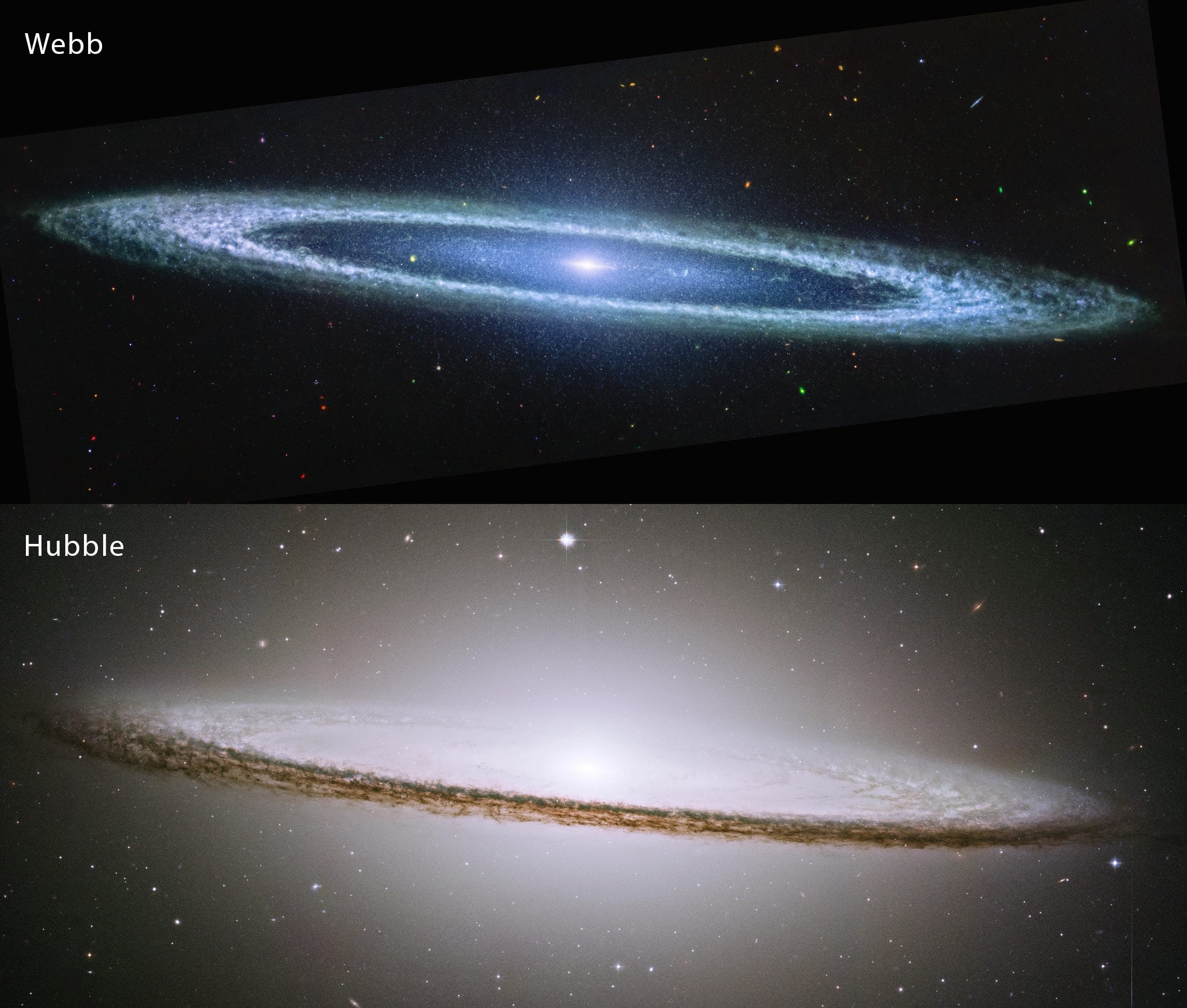
Sombrero Galaxy (M104), viewed nearly edge-on. The visible dust lane illustrates how residual baryonic material can define a disk-like system’s outer structure when seen from the side. This image is used here as a visual analogy, not as a direct equivalence: in Solar ICM, the Kuiper Belt, scattered disk, and possible Oort-region reservoir may represent faint outer boundary layers of the Solar System’s local circulation cell.
Image credit: NASA, ESA and The Hubble Heritage Team (STScI/AURA).
Source: ESA/Hubble — https://assets.science.nasa.gov/content/dam/science/missions/webb/science/2024/11/STScI-01JCGMTFA7D07SQHJX5VWCY29J.png

This image is useful for ICM because it shows how a disk system can reveal its outer material boundary when viewed from the side.
The Solar System cannot be photographed this way from outside.
But if it could be observed edge-on with sufficient sensitivity, its distant cold baryonic reservoirs might not appear as empty distance.
They might appear as a faint outer boundary structure.
A rim.
A belt.
A low-luminosity material edge.
In this analogy:
the Kuiper Belt is the inner outer-disk rim;
the scattered disk is a disturbed peripheral layer;
the Oort-region population may represent the faintest distant reservoir;
Pluto is one readable object on the inner edge of that larger outer architecture.
This does not mean the Solar System is visually identical to the Sombrero Galaxy.
It means the Sombrero Galaxy provides a useful edge-on image of what an outer baryonic rim can look like when a disk system is viewed from the side.
For ICM, this matters because it changes the imagination of the outer Solar System.
The outer Solar System should not be imagined as empty space with a few isolated objects.
It may be better imagined as a faint, cold, baryonic boundary structure.
A low-luminosity rim of residual baryonic material.
A distant edge of the local circulation cell.
In that reading, the Oort-region concept becomes especially important.
It may be the Solar System’s final external baryonic boundary.
Not a sharp wall.
But a diffuse reservoir.
A faint outer halo/rim of cold material.
The Sombrero analogy helps visualize this:
what appears empty from inside may become a rim when seen from the side.
19. The Heliosphere as the Boundary Shell
The Solar System does not end at Pluto.
It does not even end at the Kuiper Belt.
The Sun’s outward flow creates a heliosphere.
This heliosphere is the large boundary region where solar influence meets the surrounding interstellar medium.
In ICM language:
the heliosphere is the boundary shell of the local circulation cell.
This is crucial.
Because it means the Solar System has:
a center;
a disk;
an outer rim;
and a boundary shell.
This is structurally similar to how ICM reads galaxies:
central Crucible;
disk;
arms / transport layers;
halo;
external medium.
At Solar System scale:
Sun;
ecliptic disk;
Kuiper Belt;
Pluto / outer rim;
heliosphere;
interstellar medium.
This creates the full local ICM architecture.
The heliosphere also means that the Solar System is not isolated.
It is embedded.
It interacts.
It is shaped from within and constrained from outside.
Voyager 1 and Voyager 2 are especially important here.
They are not merely spacecraft that travelled far away.
They are physical probes of the boundary shell.
Voyager data show that the transition beyond the heliopause is not an empty continuation of space.
It is a different medium regime.
Voyager boundary measurements reveal that the outer Solar System is a measurable interface between solar influence and the surrounding interstellar medium.
For ICM, this is highly significant.
It means the outer Solar System is not only a mathematical limit.
It is a measurable boundary of medium exchange.
The heliosphere is therefore not only a boundary.
It is a physical interface.
A pressure-bearing zone.
A particle-filtering zone.
A place where the outward flow from the Sun meets the surrounding medium.
A place where local circulation and external environment become measurable together.
This strengthens the interpretation of the Solar System as a local circulation cell.
It also strengthens Pluto’s role as a rim marker inside a system whose outer shell is physically real, measurable, and environmentally connected.
The heliosphere is the shell.
But it is not a static shell.
It is an active boundary.
It responds.
It filters.
It exchanges.
It records the meeting of two regimes:
the local solar cell and the surrounding interstellar medium.
This section establishes the architecture.
The next section establishes the measurement.
The heliosphere is not only inferred as a shell.
Voyager measured the transition across it.
20. Voyager 1 and 2: Direct Boundary Measurements
Voyager 1 and Voyager 2 turn the heliosphere from a theoretical boundary into a measured transition.
Voyager 1 crossed the heliopause in 2012.
After the crossing, plasma-wave observations showed that the spacecraft had entered a denser plasma environment.
NASA/JPL reported that electron density around Voyager 1 began rising in 2013 and by mid-2015 reached about a 40-fold increase, remaining in a similar density range through the analyzed dataset ending in early 2020.
This is a direct measurement of a medium transition.
It shows that the outer boundary of the Solar System is not an empty continuation of the same environment.
Voyager 1 entered another medium regime.
Voyager 2 confirmed the boundary in a different way.
On 5 November 2018, Voyager 2 crossed the heliopause at about 119 AU.
At the crossing, it observed a sharp decrease in low-energy ions originating inside the heliosphere and a simultaneous increase in cosmic rays from outside.
This is exactly what a boundary interface should produce.
For ICM, this is highly significant.
The heliosphere is not only a theoretical shell.
It is a measured transition.
A density transition.
A particle transition.
A pressure-bearing interface.
A filtration boundary.
A measurable contact zone between the local solar circulation cell and the surrounding medium.
This strengthens the interpretation of the Solar System as a local circulation cell.
It also strengthens Pluto’s role as a rim marker inside a system whose outer environment is real, structured, and measurable.
The key formula is:
Voyager did not cross into nothing.
Voyager crossed into another medium regime.
21. The Heliospheric Current Sheet and Plasma-Magnetic Disk
The Solar System is not only an orbital disk.
It is also a plasma-magnetic system.
The Sun’s rotating magnetic field creates large-scale magnetic structure carried outward by the solar wind.
The heliospheric current sheet forms a vast, wavy surface through the Solar System.
This may be one of the most important local analogues to ICM.
It shows that the Solar System has not only:
orbital planes;
material dust layers;
planetary alignment;
but also:
plasma structure;
current structure;
magnetic geometry;
outward field transport.
This strengthens the model.
The Solar System is not simply an orbital clock.
It is a rotating plasma-magnetic circulation cell.
Its disk-like architecture exists across several layers at once:
orbital;
material;
plasma;
magnetic;
boundary.
This is exactly the kind of multi-layer agreement that ICM requires.
The heliospheric current sheet is especially important because it shows that the Solar System contains a large-scale electromagnetic surface associated with rotation and outward transport.
Parker Solar Probe has crossed the large-scale heliospheric current sheet multiple times, and recent work reports magnetic reconnection in the HCS accelerating protons to nearly twice the solar-wind speed and increasing core proton energy by about a factor of three in near-Sun regions.
In ICM terms:
the Solar System is not only an orbital disk.
It is a plasma-magnetic disk-like system.
This is not a minor addition.
It is one of the strongest local analogues to galactic ICM.
At galactic scale, ICM looks for the overlap of disk, plasma, magnetic structure, and environmental response.
At Solar System scale, the heliospheric current sheet offers a measurable version of that overlap.
It is the system’s electromagnetic layer.
Its existence reinforces the idea that the Solar System should not be treated as a simple geometry of bodies.
It is a rotating, field-carrying, plasma-mediated structure.
22. Parker Solar Probe and Dust Corridors
Parker Solar Probe adds another important layer.
It does not only measure near-Sun plasma and magnetic behavior.
It has also helped reveal orbital dust structure.
NASA reported that Parker Solar Probe produced the first complete view of Venus’ orbital dust ring, a band of microscopic dust particles circulating around the Sun along Venus’ orbit.
For ICM, this matters because it shows that dust in the Solar System can organize along orbital corridors.
This supports the wider idea that the Solar System contains more than isolated planets.
It contains material tracks.
Dust rings.
Particle structures.
Plasma flows.
Magnetic sheets.
Boundary interfaces.
The orbital structure is not purely mathematical.
It is physically populated.
The Venus dust ring is not the same as the Kuiper Belt, and it is not the same as the Oort-region reservoir.
But it demonstrates a general principle:
orbital corridors can accumulate material structure.
That principle matters for the outer Solar System.
If inner orbital paths can contain organized dust structures, then the outer Solar System should be examined not as empty distance, but as a possible region of faint, cold, baryonic rim structures.
This strengthens the Sombrero analogy.
It also strengthens the idea of the ecliptic as a material transport layer rather than an abstract plane.
23. Anomalous Cosmic Rays as Boundary-Exchange Evidence
The heliosphere is not only a conceptual shell.
It is a physical boundary system.
One of the strongest observational signs of this boundary behavior is the existence of anomalous cosmic rays.
Anomalous cosmic rays are important because they connect the Solar System to the surrounding interstellar medium.
In the conventional description, interstellar neutral atoms can enter the heliosphere.
After entering, they may become ionized by solar ultraviolet radiation, electron impact, or charge exchange.
Once ionized, they are picked up by the solar wind and become part of the heliospheric particle population.
Near the outer heliospheric boundary, especially around the termination shock and heliosheath, these particles can be accelerated into anomalous cosmic rays.
For ICM, this is highly significant.
It means the boundary of the Solar System is not a passive edge.
It is an exchange zone.
A filtration zone.
A particle-conversion zone.
A place where the local solar circulation system meets the surrounding medium and transforms incoming material into a new energetic population.
This supports the broader ICM interpretation:
the Solar System is not sealed from the galactic environment.
It is embedded in it, exchanges with it, and is shaped at its boundary by that interaction.
In this reading, anomalous cosmic rays become evidence that the outer heliosphere is not merely a geometric limit.
It is a physical interface.
It records:
incoming interstellar neutral atoms;
ionization inside the heliosphere;
pickup by the solar wind;
acceleration near the outer boundary;
particle exchange between the local solar cell and the surrounding medium.
This strengthens the role of the heliosphere as the boundary shell of the local circulation cell.
It also strengthens the interpretation of Pluto and the Kuiper Belt as part of the outer architecture of that cell.
Pluto does not orbit inside empty isolation.
It moves within a system that has:
an inner disk;
an outer resonant rim;
a plasma-magnetic structure;
a heliospheric boundary;
and measurable exchange with the surrounding interstellar medium.
Thus, anomalous cosmic rays provide an important observational bridge between the Solar System and the larger ICM framework.
They show that the local system is not only internally organized.
It is environmentally connected.
ACRs therefore strengthen the multi-marker argument.
They add a boundary-exchange marker to the existing architecture:
plane, spin, dust, solar wind, current sheet, Kuiper Belt, Pluto, heliosphere, and surrounding medium.
24. IBEX: Mapping the Boundary and the External Magnetic Field
Voyager gives point-crossing measurements.
IBEX adds a different kind of evidence.
It maps the boundary environment.
NASA’s IBEX mission used energetic neutral atom observations and modeling of the interstellar boundary to determine the strength and direction of the magnetic field outside the heliosphere.
This is important because the heliosphere is not shaped only from inside.
It is also shaped by the surrounding interstellar magnetic environment.
IBEX also revealed the famous Ribbon: a narrow region of enhanced energetic neutral atom emission associated with the outer heliospheric interaction region and the interstellar magnetic field geometry.
The Ribbon is especially valuable for ICM because it shows that the boundary has directionality and external magnetic organization, not only radial distance.
For ICM, this is extremely important.
It means the boundary shell is not only crossed by spacecraft.
It can be mapped.
It has structure.
It has directionality.
It has relation to external magnetic field orientation.
This supports the idea that the Solar System is embedded inside a larger medium whose properties leave measurable signatures on the local boundary.
IBEX turns the heliosphere from a simple conceptual bubble into a cartographic object.
A structure that can be read.
A structure that can be compared.
A structure that may preserve the vector of the surrounding medium.
In ICM terms:
IBEX makes the heliosphere readable as an environmental interface.
25. Cassini / INCA: Particle Pressure and Heliosheath Structure
Cassini adds another boundary layer.
Its INCA instrument observed energetic neutral atoms from the heliosphere and contributed to a revised view of the shape and physics of the Solar System’s boundary.
APL’s report on Cassini / INCA states that the solar wind’s interaction with the interstellar medium is strongly influenced by particle pressure and magnetic-field energy density, and that Cassini’s data challenged the simple comet-like shape predicted by some earlier models.
Later reviews of heliospheric structure describe Cassini / INCA observations revealing previously unexpected structures, including a “Belt” region of enhanced particle pressure inside the heliosheath.
For ICM, this is important because it supports the pressure-structure interpretation.
The heliosphere is not only a shell.
It contains pressure architecture.
It contains particle structure.
It contains regions that respond to internal flow and external medium.
This directly reinforces the ICM idea of the heliosphere as a boundary shell and barometric interface.
At galactic scale, ICM reads halos and outer structures as pressure records.
At Solar System scale, Cassini / INCA suggests that the heliosheath itself contains pressure structures.
This is a strong local analogy.
The Solar System has a measurable outer pressure regime.
That is exactly the kind of physical layer ICM needs.
This makes Cassini / INCA a pressure-structure counterpart to IBEX’s boundary-mapping role.
26. The Heliospheric Front and Tail
The heliosphere is not a perfect sphere.
It is shaped by the motion of the Solar System through the surrounding interstellar medium.
This creates directional structure.
There is an upstream side.
There is a downstream side.
There is compression toward the direction of motion and a more extended trailing region behind.
In simple visual language, the Solar System behaves less like a static bubble and more like a moving circulation cell inside a surrounding flow.
This is important for ICM.
A static spherical model cannot explain the full directional architecture of the boundary.
A moving medium-embedded model can.
In ICM terms, the heliosphere may contain an analogue of:
Medium Base → Medium Vacuum
The upstream region may act as the more compressed side.
The downstream region may act as the more extended side.
This does not require claiming a classical bow shock as a settled fact.
The stronger formulation is more careful:
the Solar System’s boundary is directionally shaped by its motion through the surrounding medium.
That is enough.
It means the local circulation cell has environmental asymmetry.
It has a front.
It has a tail.
It has a pressure gradient.
It has boundary response.
This reinforces the idea that outer objects, outer dust populations, heliospheric structure, and boundary particles should not be interpreted as isolated features.
They belong to a moving system embedded inside a larger medium.
The heliospheric front and tail also connect this update back to the Galactic Barometer update.
At galactic scale, ICM asks whether halos and disks can reveal pressure gradients in the surrounding medium.
At Solar System scale, the heliosphere may perform the same diagnostic role.
It is the local barometer.
The front is the compressed response.
The tail is the extended response.
The shell records the medium.
27. Solar Orbiter: Renewing the Ulysses Question
Ulysses proved that the Solar System must be measured outside the ecliptic.
Solar Orbiter continues that question with modern imaging and field instruments.
In 2025, ESA reported that Solar Orbiter began the high-latitude part of its mission by tilting its orbit to about 17° with respect to the Sun’s equator, opening a new polar-viewing regime after decades in which most Sun-observing spacecraft remained close to the ecliptic plane.
This matters because high-latitude solar observations are not secondary.
They are central.
The ecliptic view is incomplete.
To understand the Sun’s magnetic field, solar cycle, solar wind, and heliospheric structure, the polar regions must be measured.
For ICM, Solar Orbiter is important because it extends the Ulysses logic.
Ulysses measured high-latitude solar wind and particles.
Solar Orbiter adds high-latitude imaging and modern multi-instrument context.
Together, they reinforce the key claim:
the Solar System cannot be fully understood from the ecliptic plane alone.
The local circulation cell has vertical structure.
It has polar regimes.
It has a focused disk.
It has a boundary shell.
It has a surrounding medium.
Solar Orbiter keeps this research direction alive.
It makes the Solar System’s latitude structure a present and future observational program, not only a historical dataset.
28. ACE and Wind: The Inner Solar Medium Is Continuously Measured
The inner Solar System is also not an abstract region.
It is continuously measured as a solar-wind and interplanetary-magnetic-field environment.
NASA’s Wind spacecraft is described as a comprehensive solar-wind laboratory for long-term solar-wind measurements, observing the unperturbed solar wind near the L1 region before it impacts Earth’s magnetosphere.
ACE, also near L1, provides real-time solar-wind data used for space-weather warnings, including conditions in the solar wind and interplanetary magnetic field before they reach Earth.
For ICM, this matters because the solar medium is not hypothetical.
It is measured every day.
Speed.
Density.
Magnetic field.
Particle flux.
Solar-wind pressure.
This means that the inner Solar System is not an empty stage for orbital geometry.
It is an active plasma-magnetic environment.
ACE and Wind therefore support the foundation of Solar ICM:
the Solar System is a measured medium.
The outer boundary is measured by Voyager, IBEX, Cassini, New Horizons, and eventually IMAP.
The inner solar-wind environment is measured continuously by L1 missions.
This gives the model a multi-scale observational foundation.
This completes the inner-to-outer observational chain: ACE and Wind measure the inner solar medium; Ulysses measures latitude structure; New Horizons / SWAP measures the outer heliosphere near Pluto; Voyager measures the boundary transition; IBEX and Cassini / INCA map and diagnose the shell; IMAP may extend that boundary cartography.
29. IMAP: Future Cartography of the Boundary Shell
IMAP may become one of the most important future cartographic tools for testing Solar ICM.
NASA’s Interstellar Mapping and Acceleration Probe launched on 24 September 2025 and is designed to help researchers understand the boundary of the heliosphere — the large bubble created by the Sun that surrounds and protects the Solar System.
IMAP will investigate the boundaries of the heliosphere primarily through energetic neutral atoms.
NASA explains that ENAs allow the mission to map the boundary because neutral particles travel without being deflected by magnetic fields, carrying information from the region where they formed.
For ICM, this is a major future direction.
Voyager gave point crossings.
IBEX gave boundary mapping.
Cassini added pressure structure.
IMAP may provide a more detailed cartographic view of the heliospheric boundary.
In ICM terms:
IMAP may become the direct cartographic instrument for testing the heliospheric shell as the boundary of the local circulation cell.
This is exactly the kind of data Solar ICM needs.
A boundary map.
An environmental interface.
A global view of the shell.
A way to compare the local circulation cell with the surrounding medium.
IMAP therefore belongs in the future-testing layer of this update.
30. Multiple Planes: Not a Weakness, but Evidence of Layering
The Solar System does not have only one plane.
It has several relevant planes and surfaces:
the ecliptic plane;
the invariable plane;
the solar equatorial plane;
the Kuiper Belt mean plane;
the heliospheric current sheet;
the direction of solar motion through the surrounding medium.
These planes do not perfectly coincide.
In a simplistic model, this may look messy.
In ICM, this is meaningful.
A real medium-embedded disk should not be perfectly flat in every layer.
Different layers may have different orientations because they are governed by different parts of the system:
planets;
solar rotation;
magnetic field;
dust;
outer objects;
external medium.
This creates a shear-layer structure.
The Solar System is therefore not a flat drawing.
It is a 3D layered system.
The mismatch between planes may preserve information about internal spin, outward flow, outer rim behavior, and interaction with the galactic medium.
This is a powerful direction for future testing.
In this interpretation, imperfect alignment is not failure.
It is structure.
Layering naturally produces offsets.
Offsets can become readable.
A mature model should not erase them.
It should measure them.
This is directly connected to ICM’s wider method.
At galactic scale, offsets between optical structure, radio emission, X-ray halos, dust lanes, and spin direction may carry environmental information.
At Solar System scale, offsets between orbital planes, magnetic sheets, dust layers, heliospheric direction, and outer-object inclinations may carry analogous information.
The system becomes readable through its layered misalignments.
31. Medium-Based Distant Coupling
This is the central theoretical shift.
The distant orbit should not be imagined as a force-line stretched through empty space.
Instead, it may be read as the motion of an object inside a structured orbital medium.
Pluto is not only connected to the Sun.
It is connected to:
the ecliptic layer;
the invariable-plane architecture;
Neptune’s resonance;
the Kuiper Belt;
the outer heliospheric plasma environment;
the solar wind system;
pickup-ion populations;
the heliospheric current sheet;
the surrounding interstellar medium.
This means distant coupling can be distributed.
Not only central.
Not only local.
But layered.
In this interpretation:
Pluto is not held only across distance.
Pluto participates in a structured outer disk.
The holding structure is the system itself.
Its disk.
Its spin.
Its resonances.
Its medium.
Its rim.
Its shell.
Its external pressure.
This is the most important conceptual move of the update.
The question is no longer whether a small distant object can be imagined as attached to the Sun across an enormous gap.
The question becomes:
what is the structured medium in which that object is embedded?
This is the same kind of shift that ICM applies to galaxies.
A galaxy is not read as an isolated object in empty space.
The Solar System should not be read that way either.
The key statement is:
the Solar System is not held by a string.
It is held by structure.
This does not mean that every existing orbital calculation must be discarded.
It means that the physical interpretation may be incomplete if the structured medium is ignored.
The distance problem becomes a structure problem.
And Pluto becomes the clue.
32. Observational Chain: From Conceptual Disk to Measured Local Medium System
The strength of this update is not one observation.
It is the chain.
Ulysses measured latitude structure.
ACE and Wind continuously measure the inner solar-wind and interplanetary-magnetic-field environment.
New Horizons / SWAP measured the outer heliosphere near Pluto as a solar-wind and pickup-ion environment.
Voyager 1 and Voyager 2 measured the boundary transition.
IBEX mapped the heliospheric boundary through energetic neutral atoms and revealed boundary structure related to the external magnetic field.
Cassini / INCA added pressure-structure evidence in the heliosheath.
Parker Solar Probe strengthened the plasma-magnetic disk interpretation through heliospheric-current-sheet and dust-corridor observations.
Solar Orbiter continues the high-latitude question with modern instruments.
IMAP may extend future boundary cartography.
Together, these missions turn the Solar System from a conceptual disk into a measured local medium system.
This is the decisive point.
The Solar System is not only a set of calculated orbits.
It is measured as:
a solar-wind environment;
a latitude-structured heliosphere;
a dust-bearing system;
a plasma-magnetic system;
a pickup-ion environment;
a boundary shell;
a particle-exchange interface;
a mapped heliospheric structure;
and a moving cell embedded in the surrounding medium.
For ICM, this is the observational bridge.
The model is not built only from analogy.
It is built from a convergence of measured layers.
33. Fractal Correspondence with Galactic ICM
The Solar System may be a smaller-scale expression of the same structural logic ICM applies to galaxies.
Galactic ICM
central Crucible;
outward redistribution;
disk;
arms;
halo;
peripheral transition;
surrounding medium.
Solar ICM
Sun as local Crucible;
solar wind as outward redistribution;
ecliptic as compressed transport layer;
planetary orbits as layered circulation;
Kuiper Belt as outer disk;
Neptune as gatekeeper;
Pluto as rim marker;
New Horizons / SWAP as a measurement of the Pluto-region medium;
heliosphere as boundary shell;
Voyager as boundary-transition measurement;
anomalous cosmic rays as exchange evidence;
IBEX as boundary-shell mapping;
Cassini / INCA as pressure-structure evidence;
Parker Solar Probe as plasma-magnetic / dust-corridor evidence;
ACE / Wind as continuous inner-medium monitoring;
IMAP as future boundary cartography;
heliospheric front and tail as directional boundary response;
interstellar medium as surrounding environment.
The analogy is not based on size.
It is based on architecture.
The same form appears across scale:
center → outward flow → disk → rim → shell → exchange interface → surrounding medium
This is why Pluto matters.
It reveals the rim.
And the rim reveals the disk.
And the disk reveals the local circulation cell.
The Solar System becomes a local readable version of the same structural principle:
an energetic center organizes a rotating, layered, medium-embedded system whose outer boundary records interaction with the surrounding environment.
This is the fractal strength of the update.
ICM is no longer only a galactic-scale framework.
It becomes a possible multi-scale architecture.
The same logic may appear in different forms:
galaxies;
stellar systems;
local plasma environments;
boundary shells;
and medium-embedded rotating structures.
That does not mean every scale is identical.
It means the same organizational pattern may recur.
34. Testable Direction
This update should not remain only conceptual.
It creates a research program.
If the Solar System is a local ICM-like circulation cell, then several markers should align:
Orbital Layering
Major planets should define a compressed inner disk.
Angular-Momentum Plane
The invariable plane should act as a deeper spin-plane marker of the system.
Dust Layer
Interplanetary and zodiacal dust should show flattened distribution aligned with the system’s transport layer.
Ulysses Latitude Structure
Ulysses solar-wind data should be treated as direct evidence that the heliosphere has different equatorial and polar regimes.
Solar Wind Density / Speed Contrast
The slow, denser, more variable equatorial wind and fast, less dense, steadier polar wind should be evaluated as measured evidence for medium-layer differentiation.
Plasma-Magnetic Sheet
The heliospheric current sheet should reveal large-scale rotating magnetic structure.
Kuiper Belt Thickness
Cold and hot Kuiper Belt populations should define different thickness regimes of the outer disk.
Pluto’s Rim Role
Pluto should be read as a resonant, inclined, peripheral marker of the outer layer.
New Horizons / SWAP Plasma Context
New Horizons / SWAP data should be used to treat Pluto’s region as a measurable outer heliospheric plasma-particle environment.
Outer Solar-Wind Modification
SWAP measurements from 21 to 42 AU should be used to test whether the outer Solar System acts as a transition zone where solar wind is modified by pickup of interstellar material.
Neptune’s Gatekeeper Role
Neptune should organize the transition between the main planetary disk and the outer resonant population.
Orbital Resonance as Harmonic Pathway
Orbital resonances should be studied not only as mathematical ratios, but as possible stable corridors within the outer disk medium.
Ecliptic Focus
The ecliptic should be tested as a focus-layer by comparing planetary orbits, dust distribution, small-body populations, angular momentum, and plasma-magnetic structure.
Heliospheric Boundary
The heliosphere should act as the outer shell where the Solar System meets the surrounding medium.
Voyager Boundary Measurements
Voyager 1 and 2 boundary-crossing data should be treated as direct measurements of the transition between the local solar circulation cell and the surrounding medium.
Anomalous Cosmic Rays
Anomalous cosmic rays should be treated as evidence that the boundary shell participates in exchange with the surrounding interstellar medium.
IBEX Boundary Mapping
IBEX should be used as evidence that the heliospheric boundary can be mapped as a structured interface related to external magnetic-field geometry.
Cassini / INCA Pressure Structure
Cassini ENA observations should be used to test whether the heliosheath contains pressure structures rather than acting as a simple geometric edge.
Heliospheric Front / Tail Asymmetry
The heliosphere should be examined as a directionally shaped boundary system, with upstream compression and downstream extension relative to the surrounding interstellar medium.
Parker Solar Probe / HCS
Parker Solar Probe observations should be used to strengthen the plasma-magnetic disk interpretation, especially through heliospheric current sheet crossings and dust-ring observations.
Solar Orbiter High-Latitude Work
Solar Orbiter should extend the Ulysses problem with modern imaging and high-latitude solar observations.
ACE / Wind Long-Term Solar Medium Monitoring
ACE and Wind data should be used to reinforce that the inner Solar System is continuously measured as a solar-wind and interplanetary-magnetic-field environment.
IMAP Future Boundary Cartography
IMAP should be considered a future direct test of the heliospheric shell as a cartographic boundary structure.
Sombrero / Outer Baryonic Rim Analogy
Edge-on disk systems such as the Sombrero Galaxy should be used as visual analogies for how a cold outer baryonic rim may become visible when viewed from outside the system.
Oort-Region Boundary Reservoir
The Oort-region concept should be examined as a possible distant diffuse baryonic boundary of the Solar System, not as a sharp wall, but as a faint outer reservoir.
External-Medium Influence
Outer objects should be more sensitive to surrounding galactic and interstellar conditions than inner planets.
If these markers align, the Solar System can be studied as a local circulation cell.
If they do not align, the model must be revised.
That is the correct boundary.
The strength of the model is not one marker.
The strength is multi-marker agreement:
plane + spin + dust + solar wind + Ulysses + current sheet + Kuiper Belt + New Horizons + Neptune + Pluto + Voyager + IBEX + Cassini + Parker + IMAP + heliosphere + ACRs + front/tail asymmetry + surrounding medium
This is how the Solar System becomes readable as a local ICM system.
The critical test is whether Solar System structure becomes progressively:
thicker;
more resonant;
more inclined;
more boundary-sensitive;
and more environmentally responsive
with increasing distance from the central Crucible.
If that pattern holds, then Pluto is not an isolated distant body.
It is a marker of the outer system becoming visible.
35. Minimal Formulation
Central energetic source
→ outward solar flow
→ compressed ecliptic transport layer
→ focused orbital disk
→ harmonic resonance corridors
→ outer resonant rim
→ heliospheric boundary shell
→ exchange with surrounding interstellar medium
→ directional front/tail response
→ embedding within the galactic environment
36. Strong Formulation
The Solar System may not be only a collection of planets orbiting the Sun.
It may be a local circulation cell.
A flattened, spinning, medium-embedded disk-like system.
The Sun acts as the central Crucible.
The solar wind acts as outward redistribution.
The ecliptic acts as a compressed transport layer.
The ecliptic focus organizes the planetary angular-momentum architecture, dust populations, small bodies, and resonant structures into a flattened corridor.
Ulysses directly measured that the heliosphere has different equatorial and polar regimes.
The slow, denser, more variable equatorial wind and the fast, less dense, steadier polar wind show that the Solar System is not spherically uniform.
The giant planets define the angular-momentum framework.
Neptune acts as the outer gatekeeper.
Orbital resonances act as harmonic pathways within the disk medium.
The Kuiper Belt forms the outer disk.
Pluto marks the resonant rim.
Pluto’s inclination may record the flaring of the outer disk.
New Horizons / SWAP makes the Pluto region measurable as a solar-wind and pickup-ion environment.
The heliosphere forms the boundary shell.
Voyager 1 and Voyager 2 show that the outer boundary of the Solar System is not empty continuation, but a measurable transition into another medium regime.
Anomalous cosmic rays reveal that this boundary shell is also an exchange interface between the solar circulation cell and the surrounding interstellar medium.
IBEX maps the boundary as a structured interface influenced by external magnetic-field geometry.
Cassini / INCA suggests pressure structure inside the heliosheath.
Parker Solar Probe strengthens the plasma-magnetic disk interpretation through heliospheric current sheet and orbital dust measurements.
IMAP may become the future cartographic instrument for testing the heliospheric shell as the boundary of the local circulation cell.
Together, Ulysses, ACE/Wind, New Horizons/SWAP, Voyager, IBEX, Cassini/INCA, Parker Solar Probe, Solar Orbiter, and IMAP form an observational chain from the inner solar medium to the outer boundary shell.
The heliosphere therefore becomes not only a shell, but a directional, pressure-bearing, particle-filtering, exchange-active interface between the local solar cell and the surrounding galactic environment.
In this framework, Pluto’s distance is not the main mystery.
Its role is.
Pluto may reveal the outer cadence, thickness, resonance, and boundary behavior of the Solar System’s local disk.
The distant orbit is not a line stretched through emptiness.
It is participation in a structured orbital medium.
37. Status
This update does not claim that the Solar System and a galaxy are physically identical.
It does not claim that Pluto alone proves the full ICM framework.
It does not claim that one mechanism explains all orbital behavior.
It does not claim that conventional orbital calculations are useless.
It proposes a structural interpretation:
the Solar System may be read as a local ICM-like circulation cell, where distant orbital stability is not understood only as a center-to-object relation, but as participation in a layered disk-medium system.
The observational facts are not treated as speculative. The interpretation is what ICM contributes: it reads these measured layers as parts of a local circulation cell.
This interpretation should be tested through:
planetary inclination distributions;
invariable-plane geometry;
zodiacal dust structure;
Kuiper Belt population thickness;
Pluto’s resonance and inclination;
Pluto–Charon boundary structure;
Neptune’s outer-gatekeeper role;
orbital resonance mapping;
Ulysses high-latitude solar-wind data;
Ulysses dust measurements;
New Horizons / SWAP outer-heliosphere data;
Voyager 1 and 2 boundary measurements;
IBEX boundary mapping;
Cassini / INCA heliosheath structure;
Parker Solar Probe heliospheric current sheet and dust-ring data;
Solar Orbiter high-latitude observations;
ACE / Wind solar-wind and IMF monitoring;
IMAP future ENA boundary maps;
heliosphere/interstellar-medium interaction;
heliospheric front/tail asymmetry.
The model stands or falls on multi-marker agreement.
This update should therefore be read as a proposed diagnostic framework.
Not as a final conclusion.
Its purpose is to change the question:
not only what pulls a distant object?
but:
what structured medium carries the outer architecture of the system?
This is the correct boundary.
ICM becomes strongest when it does not demand belief.
It becomes strongest when it offers a testable way to read structure.
38. Closing Statement
Pluto is not merely distant.
Pluto is peripheral.
It sits near the outer architecture of the Solar System’s disk-like structure.
Its orbit, inclination, resonance, binary relationship with Charon, and position near the Kuiper Belt may make it one of the most important boundary markers of the local circulation cell.
The Solar System is not a sphere of empty distance around the Sun.
It is a structured, flattened, spinning, plasma-magnetic, medium-embedded system.
The Sun is the local Crucible.
The ecliptic is the compressed transport layer.
The ecliptic focus is the flattened corridor of orbital organization.
Ulysses measured the difference between the ecliptic/equatorial and polar regimes.
Neptune is the gatekeeper.
Pluto is the rim marker.
Resonance is the harmonic pathway.
The Kuiper Belt is the outer disk.
The Sombrero Galaxy provides a visual analogy for how a disk system may reveal a cold outer baryonic rim when seen edge-on.
The heliosphere is the shell.
Voyager measured the boundary transition.
Anomalous cosmic rays show that the shell is also an exchange interface.
IBEX maps the outer boundary.
Cassini reveals pressure structure.
New Horizons measures the outer heliosphere near Pluto.
Parker measures the inner plasma-magnetic architecture.
IMAP may map the shell more fully.
Together, these missions turn the Solar System into a measured structure, not merely a calculated diagram.
The surrounding galactic medium is the environment.
In this interpretation, the question changes.
Not only:
how does Pluto remain so far away?
But:
what does Pluto reveal about the hidden disk that carries it?
And more broadly:
what does the Solar System reveal about the medium in which it is embedded?
Key Formulas
Pluto is not merely distant. Pluto is peripheral.
The Solar System is not a sphere of empty distance. It is a local circulation cell.
The ecliptic is not only a plane of orbits. It may be a compressed transport layer.
The ecliptic is not only a plane. It is a focus-layer.
Ulysses measured the Solar System as a latitude-structured medium.
The ecliptic regime and the polar regime are not physically equivalent.
The Sun is not only the center. It is the local Crucible of outward redistribution.
The distant orbit is not a line stretched through emptiness. It is participation in a structured orbital medium.
Neptune is the gatekeeper. Pluto is the rim marker. The heliosphere is the shell.
Orbital resonance may be a harmonic pathway of the disk medium.
Pluto is not the clock of the whole Solar System. It may be the cadence marker of the outer resonant rim.
Pluto’s inclination may be read as outer-disk flaring.
New Horizons / SWAP makes the Pluto region measurable as a plasma-particle environment.
The Solar System is not only an orbital disk. It is a plasma-magnetic disk-like system.
The heliosphere is not only a boundary. It is an exchange interface.
Voyager did not cross into nothing. It crossed into another medium regime.
IBEX makes the heliosphere readable as an environmental interface.
Cassini / INCA reveals that the heliosheath contains pressure structure.
Parker Solar Probe strengthens the plasma-magnetic disk interpretation.
IMAP may become the cartographic test of the local circulation shell.
The heliosphere is not a static bubble. It is a moving boundary structure.
The Solar System is not held by a string. It is held by structure.
The gaps between planets are not empty; they are filled with the tension of the medium.
The Oort-region concept may represent the Solar System’s most distant diffuse baryonic boundary.
The Solar System is not only calculated. It is measured as a medium.
Ulysses measures the latitude structure. Voyager measures the boundary transition. New Horizons / SWAP measures the Pluto-region medium. IBEX and Cassini / INCA map and diagnose the shell.
Pluto does not only orbit far away. It may reveal the rim structure of the Solar System’s hidden disk.
The Solar System may be a miniature ICM architecture: central Crucible, outward flow, disk, rim, shell, exchange interface, and surrounding medium
Author: Artur Chindyaskin
Independent Researcher
LinkedIn:
https://www.linkedin.com/in/artur-chindyaskin/
Full framework, updates, and further developments of the Interlayer Circulation Model (ICM) will continue under the authorship of Artur Chindyaskin.
Materials Used
https://sci.esa.int/web/ulysses/-/47369-fact-sheet
Description:
Official ESA fact sheet for the Ulysses mission. It confirms that Ulysses operated for about 17 years, completed three solar orbits, performed six polar passes, and followed a highly inclined heliocentric orbit of about 80° to the solar equator.
How it is used in the update:
This source supports the claim that Ulysses measured the Solar System outside the ordinary ecliptic viewpoint and turned the heliosphere into a three-dimensional measured system.
2. ESA — Ulysses Solar Wind Speeds
https://sci.esa.int/web/ulysses/-/42902-solar-wind-speeds
Description:
ESA material describing Ulysses observations of solar-wind speed by heliographic latitude. It shows fast polar solar wind around 750 km/s and slower equatorial wind around 350–400 km/s during solar minimum conditions.
How it is used in the update:
This supports the key ICM claim that the ecliptic/equatorial regime and the polar regime are physically different solar-medium regimes, not merely different viewing directions.
3. NASA/MSFC — Results from Ulysses that Motivate the Solar Probe Mission
https://solarscience.msfc.nasa.gov/people/suess/SolarProbe/Page3.htm
Description:
NASA/MSFC summary comparing slow and fast solar wind. It gives a useful quantitative contrast: slow wind around 400 km/s with density around 7 cm⁻³, and fast wind around 750 km/s with density around 3 cm⁻³.
How it is used in the update:
This source supports the section on Ulysses and the measured latitude structure of the solar medium. It strengthens the argument that the Solar System has measurable plane/pole differentiation.
4. ESA — Sixteen Years of Ulysses Interstellar Dust Measurements
https://sci.esa.int/web/ulysses/-/56678-strub-et-al-2015
Description:
ESA publication summary on long-term Ulysses interstellar dust measurements. It discusses interstellar dust inside the Solar System, long-term monitoring, solar-cycle effects, Lorentz-force filtering, a reported 50° ± 7° dust-flow direction shift, and a strong flux change in 2005.
How it is used in the update:
This supports the argument that the Solar System contains measurable particle populations and should not be imagined as an empty geometric space between planets.
5. Ulysses Dust Data 2005–2007 Paper
https://pages.astro.umd.edu/~dphamil/research/DPHreprints/KruDikAnw10.pdf
Description:
Scientific paper discussing Ulysses dust data from 2005–2007, including high-ecliptic-latitude dust measurements, interstellar dust stream behavior, radiation pressure, gravitational focusing, and Lorentz-force effects.
How it is used in the update:
This source helps clarify that the Solar System contains multiple dust and particle populations with different spatial behavior. It supports the broader “materiality of the medium” argument.
6. NASA/JPL — Voyager 1 Density Measurements in Interstellar Space
https://www.jpl.nasa.gov/news/as-nasas-voyager-1-surveys-interstellar-space-its-density-measurements-are-making-waves/
Description:
NASA/JPL article reporting that electron density around Voyager 1 began rising in 2013 and by mid-2015 reached about a 40-fold increase compared with early post-heliopause measurements.
How it is used in the update:
This is one of the strongest sources for the claim that Voyager 1 did not move into an empty continuation of the same environment, but entered a different plasma regime beyond the heliopause.
7. Nature Astronomy / ADS — Voyager 2 Cosmic Ray Measurements at the Heliopause
https://ui.adsabs.harvard.edu/abs/2019NatAs...3.1013S/abstract
Description:
Scientific abstract on Voyager 2 measurements during its heliopause crossing on 5 November 2018 at about 119 AU. It reports a sharp decrease in low-energy ions from inside the heliosphere and a simultaneous increase in cosmic rays from outside.
How it is used in the update:
This supports the section on Voyager 1 and 2 as direct boundary measurements. It strengthens the claim that the heliopause is a measurable particle-transition interface.
8. SwRI — New Horizons/SWAP Confirms Solar Wind Slows Farther Away from the Sun
https://www.swri.org/newsroom/press-releases/swri-built-instrument-confirms-solar-wind-slows-farther-away-the-sun
Description:
SwRI report on New Horizons/SWAP measurements from 21 to 42 AU. It states that the solar wind slows farther from the Sun as it picks up interstellar material, with the solar wind between 33 and 42 AU measured about 6–7% slower than at 1 AU.
How it is used in the update:
This is a key source for treating the Pluto region as a measurable outer-heliosphere plasma-particle environment, not merely a distant orbital location.
9. New Horizons/SWAP Instrument Paper
https://www2.boulder.swri.edu/pkb/ssr/ssr-swap.pdf
Description:
Technical paper on the Solar Wind Around Pluto instrument carried by New Horizons. It explains SWAP’s role in measuring solar wind and pickup ions in the outer heliosphere and near Pluto.
How it is used in the update:
This supports the section “New Horizons / SWAP: Measuring the Plasma Environment Near Pluto.” It helps anchor the claim that Pluto’s region is physically measurable as a plasma-particle regime.
https://wind.nasa.gov/
Description:
NASA page describing Wind as a “Comprehensive Solar Wind Laboratory for Long-Term Solar Wind Measurements.” It notes that Wind observes the unperturbed solar wind upstream of Earth.
How it is used in the update:
This supports the claim that the inner Solar System is continuously measured as a solar-wind and interplanetary-magnetic-field environment.
11. NOAA — ACE Real-Time Solar Wind
https://www.swpc.noaa.gov/products/ace-real-time-solar-wind
Description:
NOAA page describing ACE real-time solar-wind data from the L1 region. ACE data are used for monitoring upstream solar-wind conditions and issuing space-weather warnings.
How it is used in the update:
Together with Wind, ACE supports the argument that the solar medium is not hypothetical. It is measured continuously through speed, density, magnetic field, and particle conditions.
12. AGU / Geophysical Research Letters — Parker Solar Probe Observations of HCS Reconnection
https://agupubs.onlinelibrary.wiley.com/doi/full/10.1029/2021GL096986
Description:
Scientific paper on Parker Solar Probe observations of energetic proton beams produced by magnetic reconnection near the heliospheric current sheet. It discusses proton acceleration and increased proton core energy in HCS-related regions.
How it is used in the update:
This supports the section on the heliospheric current sheet and the Solar System as a plasma-magnetic disk-like system.
13. NASA — Parker Solar Probe Sees Venus Orbital Dust Ring
https://www.nasa.gov/solar-system/nasas-parker-solar-probe-sees-venus-orbital-dust-ring-in-1st-complete-view/
Description:
NASA article reporting Parker Solar Probe’s first complete view of the dust ring along Venus’ orbit, made of microscopic dust particles circulating around the Sun along Venus’ orbital path.
How it is used in the update:
This supports the “Parker Solar Probe and Dust Corridors” section. It shows that orbital paths can contain material dust structures, strengthening the ecliptic-focus and outer-rim analogy.
14. IBEX Mission Archive — Ribbon and External Magnetic Fields
https://ibex.swri.edu/archive/2009.10.15.shtml
Description:
IBEX mission archive page explaining the discovery of the IBEX Ribbon and its relationship to magnetic fields outside the heliosphere.
How it is used in the update:
This supports the claim that the heliospheric boundary has directionality and external magnetic organization, not merely radial distance.
https://ibex.princeton.edu/graphics
Description:
IBEX graphics and visual material, including all-sky energetic neutral atom maps and Ribbon visualizations.
How it is used in the update:
This supports the claim that IBEX turns the heliosphere into a map-like structure that can be visually and analytically compared.
16. Johns Hopkins APL — Cassini Helps Redraw Shape of Solar System
https://www.jhuapl.edu/news/news-releases/091015-cassini-helps-redraw-shape-solar-system
Description:
Johns Hopkins APL article discussing Cassini/INCA observations of energetic neutral atoms and their implications for the shape and pressure structure of the heliosphere.
How it is used in the update:
This supports the claim that the heliosphere is not only a geometric shell, but a pressure-bearing boundary structure shaped by particle pressure and interaction with the surrounding medium.
17. Space Science Reviews — Global Heliosphere as Seen by Voyager and Cassini ENAs
https://link.springer.com/article/10.1007/s11214-022-00889-0
Description:
Scientific review of the global heliosphere using Voyager and Cassini energetic neutral atom observations. It discusses unexpected heliospheric structures, including enhanced particle-pressure regions inside the heliosheath.
How it is used in the update:
This strengthens the Cassini/INCA pressure-structure section and supports the idea that the heliosheath contains measurable pressure architecture.
18. ESA — Solar Orbiter Gets World-First Views of the Sun’s Poles
https://www.esa.int/Science_Exploration/Space_Science/Solar_Orbiter/Solar_Orbiter_gets_world-first_views_of_the_Sun_s_poles
Description:
ESA article reporting Solar Orbiter’s 2025 high-latitude phase, including a tilt of about 17° with respect to the Sun’s equator and first polar-viewing observations.
How it is used in the update:
This supports the section “Solar Orbiter: Renewing the Ulysses Question.” It shows that high-latitude solar observation remains an active observational frontier.
https://science.nasa.gov/mission/imap/
Description:
NASA mission page for the Interstellar Mapping and Acceleration Probe. IMAP is designed to map the boundaries of the heliosphere and study interaction between the heliosphere and the local galactic neighborhood.
How it is used in the update:
This supports the section on IMAP as a future cartographic tool for testing the heliospheric boundary shell as part of Solar ICM.
20. NASA SVS — IMAP ENA Boundary Mapping Visualization
https://svs.gsfc.nasa.gov/14811/
Description:
NASA Scientific Visualization Studio explanation of how IMAP uses energetic neutral atoms to map boundary regions of the heliosphere, because neutral particles can travel without being deflected by magnetic fields.
How it is used in the update:
This explains why IMAP is relevant as a boundary-cartography dataset for the local circulation cell.
21. ESA/Hubble — Sombrero Galaxy Image and Description
https://esahubble.org/images/opo0328a/
Description:
ESA/Hubble page describing the Sombrero Galaxy as nearly edge-on, with a bright central bulge and thick dust lanes encircling its spiral structure. It notes the viewing angle of about six degrees north of the equatorial plane.
How it is used in the update:
This supports the Sombrero analogy. It provides a visual example of how a disk system can reveal an outer baryonic rim when viewed nearly edge-on.